


“If I could shoot a game bird and still not hurt it, the way I can take a trout on a fly and release it, I doubt if I would kill another one. This is a strange statement coming from a man whose life is dedicated to shooting and gun dogs. For me, there is almost no moment more sublime than when I pull the trigger and see a grouse fall. Yet, as the bird is retrieved I feel a sense of remorse for taking a courageous life. About the time I passed fifty I noticed this conflict becoming more pronounced.” GBE
I first read this quote a good three years ago and I was immediately taken aback by the message and how hard it hit home within my own conscience. Now I may not be 50 years of age, but the wellness of the ecosystem I love so dearly and more importantly the wondrous fauna and flora we are blessed with mean a very great deal to me, and I could not think of a sadder day than having to train and run my beloved Pointers on pen raised birds. It is a very fitting quote I feel many a hunter in our modern day, ‘if it flies it dies’, narrow mindedness should take on board. We have become enshrined in a fill the bag at all costs approach and it downright disrespects the very nature we as hunters should all be preserving more than the so called (and very vocal) bunny huggers do. I don’t think the majority of hunters realise that without the sustainable and responsible approach to hunting and our fauna, we will be forced to take to the clay range a whole lot more… Then again, is that such a bad thing? Many lives would be spared instead of inflating the ego. Having been a hunter all my life and done my fair share of “killing” I have always been in love and in awe of the magic of a well trained gundog. There isn’t anything quite like it in this all too mundane world in my opinion. The bond that exists between man and dog, hunter and companion, and more importantly, friend and friend. It is a bond and sense of companionship, team work if you will, that goes all the way back to our very beginning.
I was 9 years old when I got my first gundog and from that moment I knew nothing would be the same again. I trained him and all my dogs thereafter all on my own, in my garden, in the pool, setting up hunting scenarios and tests to the best of my knowledge and I enjoyed countless happy hours afield with him as well as the dogs to follow.
When I was 15 years old I acquired my first Pointer, and this is where the game changed forever. While on this subject I’d like to settle the confusion once and for all, the Pointer is often referred to and called the English Pointer, incorrectly. It is very plainly and simply, a Pointer. The continental breeds can and should be distinguished by their country of origin but the Pointer is very simply just that.
In my mind, there is little to compare to a hard running, head high, air searching, athletic pointer tearing up the ground effortlessly on its pursuit of the faintest flicker of body scent. They reach scary speeds whilst still maintaining grace, poise and finesse and will stop in a flash at the first thread of scent, slamming to a halt into a rigid, statuesque work of art sometimes hundreds of meters ahead of handler and hunter and will hold the quarry there patiently for its master to report to the scene. The Pointer is the master of the big country, the wide open spaces and he makes it look like fine art. No other breed compares to its appeal and its style. I am of course a self confessed Pointer fanatic but I appreciate every single breed for they all have their place in the hunting and working world. All terrains, all species and even climates dictate the use of a specific breed. It is nigh impossible to select the perfect breed to do it all, and while some may argue this point, it is impossible. Choose your breed according to what will suit you and your hunting needs best Taking the terrain you hunt into consideration, the species you mainly pursue and the climate you will find yourself in mostly, not to mention your living situation at home, as certain gundog breeds can be a real handful.
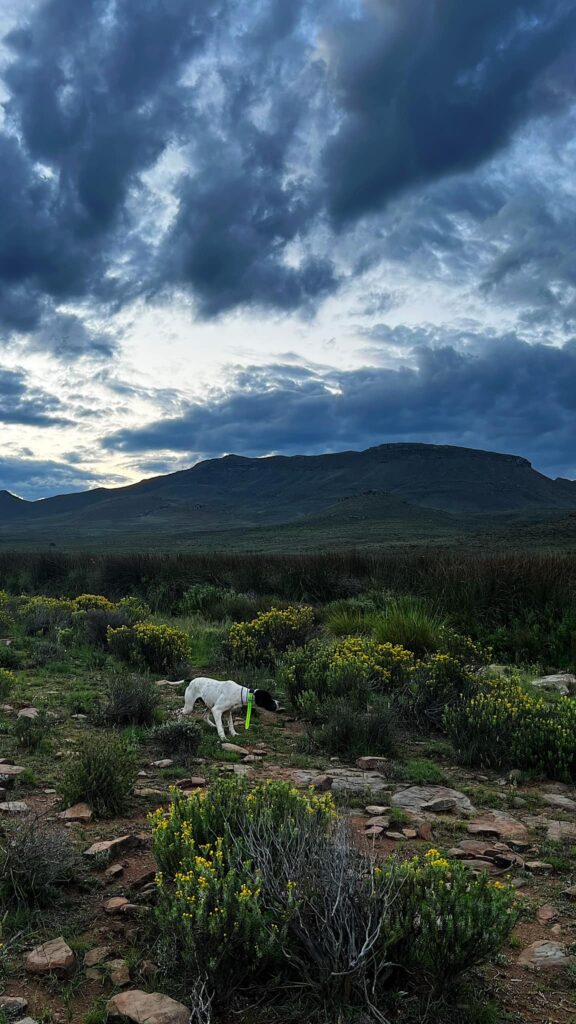
Of late, I have volunteered to do some research on the elusive and cunning Greywing Francolin in an area not very researched before, the North Eastern Free State region of Memel, deep in the Witteberg mountain range. The birds were confirmed to be there but their numbers, DNA, genealogy and habits were not very well known, if at all. My base is an old boat house within this mountain range next to a large dam. It truly is another world deep in these mountains and has quickly become my favourite place which I have yet visited. In finding these birds, I naturally would require dogs to locate these cunning birds in these vast, montane, grassland expanses.
For those not too clued up on the Greywing Francolin, it is without doubt the champagne offering of Africa’s wingshooting smorgasbord. They are incredibly fast flying birds of medium size which prefer elevated, mountainous and grassland areas. They occur in large coveys, and coveys of 20-25 birds are not uncommon, especially in the Eastern Cape region. They are scratchers and use their strong beaks to dig for bulbs and corms, often referred to as “uintjies” by the local South African farming community. They are the only grassland francolin which if hunted and shot responsibly can and will replenish and stand up to the numbers cropped through the responsible shooting of them annually. They provide a sound option for commercial wingshooting if the above rules are adhered to strictly. They are by far our most sporting and challenging of birds to shoot as the habitat in which they are found is challenging enough to most hunters and requires a decent level of fitness and mobility. They erupt from the sparse cover at lightning speeds and use any prevailing winds to swoop and dip and hug the hillsides for safety. They are a magical little bird and they hold a special place in my heart.
I traverse many kilometres each and every single day whilst surveying and finding the territorial coveys so I can mark their spots and gain some familiarity with them and their family sizes and very importantly the birds ages. In these days I have witnessed some unbelievable sights and memorable dog work from my current two young Pointers. On my last outing, I noticed the older of my dogs, Lucia, had come to a halt on a hillside some 350 yards away, I saw the young dog some distance off (I later paced out 90 paces) backing her (also commonly referred to as honouring the point). I made my way over slowly and Lucia had kept the covey calmly there for me to approach. At the scene, I slowly made my way around her and into the area she was indicating to hold birds and as per usual encouraged her to ‘produce the birds with me’, in a flash the immense stillness and almost deafening silence of the hills was abruptly interrupted by a whirl of feathers and a cacophony of screeching staccato, 9 birds were in the sky and were heading over the rise, as they got near the crest, a bird of prey came swooping out of seemingly nowhere like a fighter jet and slammed into one of the birds which fell immediately. My two dogs were well behaved and steady to the flushing of the birds as well as to the shot I pulled off from a starter pistol. In disbelief at what I just saw I patted the dogs and recast them on their way to hunt as far off from the scene as possible, but after a few minutes, the youngster, Fabia, went on point near where I saw the bird go down, upon my arrival I found she was pointing the dead bird and I put them both on leads and went in the other direction to allow the bird to come and enjoy its hard earned meal. The nose of a good pointing dog will astound even the most well versed foot hunter and the things I witness whilst out in these mountains, like this incident for example, really are unbelievable and vivid memories I recall during the stressful times living in the city can bring about.
The Greywing is a true survivor as when there is time of drought and food seems to be in shortage to most other bird species, they are hardy enough to find their food, survive and raise their clutches successfully year round. This particular covey I spoke of with the raptor incident actually had its second clutch of the season which I found in quite a few of the coveys in this region. There is little to beat or rival hunting Greywing in the mountainous retreats they inhabit with good, far ranging pointers and I truly believe it is an experience that true wingshooters the world over will start to buy into more and more especially with how the ever struggling ZAR is performing against the global currency leaders. There is an experience in this hunt and endeavour that few species can compete with, and the more we can convince the hunter that the experience as a whole takes precedence over the actual kill, I feel that the gamebirds of Southern Africa will be left in a much healthier situation. The enjoyment derived from working gundogs on wild cunning birds, where we never pen raise and release any species in our country, provides the ultimate test for a gundog and a lot more hunters should buy into the idea of working their dogs without the need to always kill. A term I have coined of late which fits the topic of conversation perfectly is ‘Green killing’. Working pointing dogs on the wild birds as you would whilst hunting, but firing a blank round into the air instead of killing every single bird found, would really do the worlds game bird populations a solid deed. Without these magical birds we have no sport so in my mind it really is a no brainer to be doing our bit of conservation to preserve them. The more in depth our understanding of these birds becomes, the greater our level of sympathy towards their plight and struggle in surviving and raising their young each year.
Hunting the Greywing is not for the faint of heart as I mentioned previously, a relative amount of fitness and mobility is required and more importantly a good shot as these birds provide the most challenging of targets whilst they make their escape. The way they use the prevailing winds and hug the slopes or hillsides is something to marvel and they tower so well that invariably your standard “going away shot” is almost non existent. With experienced steady pointing dogs holding the covey calmly, guns can often be arranged around the breathtaking landscapes these birds inhabit, in likely spots the flushed birds would fly toward, and the handler can then flush the birds, creating a hybrid form of ‘driven grouse shooting’ but purely mixing it up so as to avoid the mundane going away shot.
Due to my innate understanding of these birds, my affection towards them, as well as my dogs ability to handle and locate these cunning birds through their unrivalled exposure to them I am very often asked to help out surveying new grounds and areas. I am also asked to help guides who take hunters out with my dogs to ensure their clients fill their bag limits and have a decent day out with good dog work. Bag limits are correctly put in place to ensure coveys are not shot out and quite often once a covey has been shot, it is left alone the entire season. Bag limits are generally 4-6 birds per gun per day depending on the area and province but I personally feel 4 birds per gun per day is the more responsible option for the longevity of this special bird. Not more than 25% of a covey may be shot.
My training philosophy for all my dogs revolves around Greywing as they are the hardest birds for a dog to handle and work out due to their ability to almost vanish into non existent cover and they will often lead a dog on a merry chase with zero success! I run my puppies from around 4 months old on Greywing because I truly believe that a dog that can handle and master Greywing intrinsically from a young age has no problem whatsoever working out other game birds, conversely, a dog that grows up and gains its hunting experience on our other game bird species, once put on Greywing for the first time, really struggles. This is why they are the Holy Grail of South Africa’s game birds and the unrivalled king of the vast open expanses. Dogs should run head up, using the winds and if a dog grounds scents they invariably “bump” the birds and flush them prematurely. My standard for my dogs include the following, head high, independent searching and hunting, confidence on birds, discipline (my dogs sit or drop to flush and do not chase or snap at birds, even whilst hunting and birds are shot), under control, working in harmony with handler and or owner, complete respect of the other dog ie backing or honouring the point and absolutely no jealousy towards another dog. I have a high standard and I do not intend swaying from it ever. I like my dogs to cast far and hard too, them finding birds at 300/400 meters is not uncommon, and they must have the patience, composure and will to work with me to hold those birds long enough for me to get there and only then will they be allowed to produce the birds with me, because it is teamwork and not an individual’s day out to have fun.
Our beautiful country is blessed with such a wide variety of game, both feathered and furred, and I truly never want to see the day we would have to pen raise and release birds each hunting season. It would be a sad, sad day indeed. So as to avoid something so villainous happening, we as the active hunting community need to make a concerted effort to take care of our bird numbers and respect the designated seasons when hunting is allowed and furthermore in the season, to uphold the very necessary bird limit imposed per species and per hunter.
My message is relatively simple, start putting the birds (and all game actually) outrightly first. Think twice before squeezing off a double, or left and right. Do not shoot young birds. Do not chase up coveys over and over again. Perhaps even shoot your bag limit as early as possible and then just work your dog the rest of the day out. Make use of your felled quarry in the kitchen. Get so lost in your dogs work and be so contented with what you just witnessed that seeing a puff of feathers is actually a bad ending. Never shoot birds out of season. Back off and stay away from even training your dog on wild birds in breeding season so as not to disrupt nests, chicks and juveniles. Really think about how far down the food chain a game bird actually is, the struggle they face to rear young and still fend for themselves, almost every predator in Africa can hunt and kill our terrestrial game birds.
I will leave you with another one of my favourite quotes to help the above message have more of an impact;
‘The child tells what he got for Christmas, the mature man tells how he spent the day; the immature hunter tells how many birds he shot, the mature gunner tells of the experience. If I can impart a sense of gunning values through my writing, I urge the gunner at any age to lift himself above the childish state of mind, thinking only of himself and not what he is doing to the birds.’
Always chasing the horizon.